Agile Employee Survey 4.0
SMART Feedback – bottom-up vs. top-down
The SMART FED feedback portal, with its “Agile Employee Survey 4.0” approach, offers an alternative method for identifying the root causes of employee turnover, demotivation, or lack of engagement in organizations.
When you go to a doctor, you do not want your symptoms to be measured. That is, how severe the pain is or how unwell you feel. You want the doctor to identify the underlying causes of these symptoms and take measures to treat those causes specifically.
This is precisely where the core problem of traditional survey methodology lies. Due to its conceptual approach – a few general questions about overall well-being – the method can only measure symptoms. It merely “scratches” the surface in order to generate metrics on employee satisfaction or engagement. At best, it provides general indications of possible causes as to why satisfaction or engagement continues to decline. But only if the right questions are asked at the right time and in the right place.
The SMART-FED-Method
For this reason, SMART FED has replaced traditional survey methodology with a conceptually new agile survey approach.
With SMART FED, the focus is no longer on employees rating their satisfaction or engagement at a specific point in time X. Instead, they should be able at any time to evaluate what specifically influences their satisfaction, engagement, or performance capability. And this individually in the context of their tasks, their supervisors, their team, their personal values, as well as other experiences and observations in the work environment.
In order to derive quantifiable and relevant information for the organization from employees’ individual evaluations, SMART FED aggregates and analyzes the feedback in temporal, thematic, and organizational contexts.
In medical terms, SMART FED is an organizational CT scan that precisely makes visible the causes leading to dissatisfaction, lack of engagement, or insufficient performance capability among employees.
This new methodological approach results in substantial advantages for corporate management and organizational development.
1. Evaluations can be better weighted and assigned within temporal, thematic, and organizational contexts.
2. Feedback is timely and up to date. Significant changes within an organization are immediately recognizable.
3. Feedback is authentic and reliable. Employees do not evaluate something because they are forced to do so, but because it is personally relevant to them in their daily work.
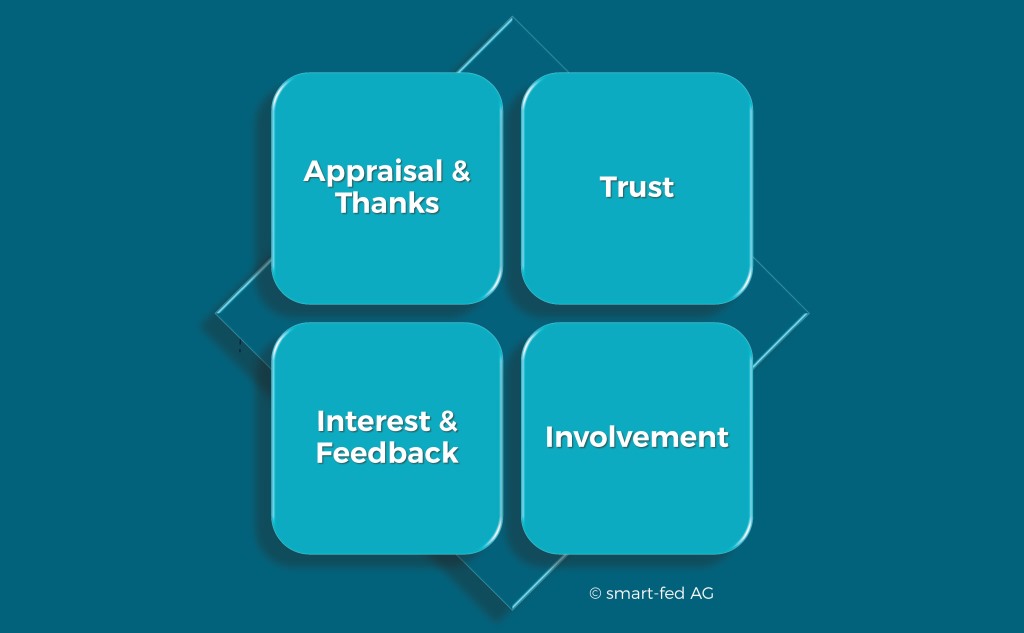
4. SMART FED no longer limits surveys to the perspectives of “satisfaction” and “engagement,” but encompasses all organizational aspects that directly or indirectly influence employees’ performance and performance capability.
5. Due to the multidimensional analysis provided by SMART FED, management immediately recognizes whether action is required at all, where action is needed, and with what priority.
6. Employees feel valued, as they are able to openly and freely communicate their experiences and observations to the organization.
Conclusion
The “Agile Employee Survey 4.0” approach is not merely a new marketing buzzword, but delivers real added value for companies.
SMART FED is a real-time analysis of real and concrete changes within organizations – not a time-delayed measurement of symptoms reflecting how the organization felt at some point in the past.
Only this approach enables management to recognize strengths, opportunities, and risks within the organization in a timely manner.
⇒ Author: Martin Mechlinski / SMART FED
Agile Employee Survey 4.0
SMART Feedback
bottom-up vs. top-down
The SMART FED feedback portal, with its “Agile Employee Survey 4.0” approach, offers an alternative method for identifying the root causes of employee turnover, demotivation, or lack of engagement in organizations.
When you go to a doctor, you do not want your symptoms to be measured. That is, how severe the pain is or how unwell you feel. You want the doctor to identify the underlying causes of these symptoms and take measures to treat those causes specifically.
This is precisely where the core problem of traditional survey methodology lies. Due to its conceptual approach – a few general questions about overall well-being – the method can only measure symptoms. It merely “scratches” the surface in order to generate metrics on employee satisfaction or engagement. At best, it provides general indications of possible causes as to why satisfaction or engagement continues to decline. But only if the right questions are asked at the right time and in the right place.
The SMART-FED-Method
For this reason, SMART FED has replaced traditional survey methodology with a conceptually new agile survey approach.
With SMART FED, the focus is no longer on employees rating their satisfaction or engagement at a specific point in time X. Instead, they should be able at any time to evaluate what specifically influences their satisfaction, engagement, or performance capability. And this individually in the context of their tasks, their supervisors, their team, their personal values, as well as other experiences and observations in the work environment.
In order to derive quantifiable and relevant information for the organization from employees’ individual evaluations, SMART FED aggregates and analyzes the feedback in temporal, thematic, and organizational contexts.
In medical terms, SMART FED is an organizational CT scan that precisely makes visible the causes leading to dissatisfaction, lack of engagement, or insufficient performance capability among employees.
This new methodological approach results in substantial advantages for corporate management and organizational development.
1. Evaluations can be better weighted and assigned within temporal, thematic, and organizational contexts.
2. Feedback is timely and up to date. Significant changes within an organization are immediately recognizable.
3. Feedback is authentic and reliable. Employees do not evaluate something because they are forced to do so, but because it is personally relevant to them in their daily work.
4. SMART FED no longer limits surveys to the perspectives of “satisfaction” and “engagement,” but encompasses all organizational aspects that directly or indirectly influence employees’ performance and performance capability.
5. Due to the multidimensional analysis provided by SMART FED, management immediately recognizes whether action is required at all, where action is needed, and with what priority.
6. Employees feel valued, as they are able to openly and freely communicate their experiences and observations to the organization.
Conclusion
The “Agile Employee Survey 4.0” approach is not merely a new marketing buzzword, but delivers real added value for companies.
SMART FED is a real-time analysis of real and concrete changes within organizations – not a time-delayed measurement of symptoms reflecting how the organization felt at some point in the past.
Only this approach enables management to recognize strengths, opportunities, and risks within the organization in a timely manner.
⇒ Author: Martin Mechlinski / SMART FED