Pulse Surveys
The Feedback Theater in Organizations
Why pulse surveys are not an alternative to traditional employee surveys
Pulse Surveys
The Feedback Theater in Organizations
Why pulse surveys are not an alternative to traditional employee surveys
Many companies today face a dilemma: traditional, rigid annual surveys are considered outdated, slow, and bureaucratic. As a modern savior, pulse surveys have therefore been introduced.
The logic behind them sounds appealing: if we increase the frequency and “pulse” employees weekly or monthly with short questionnaires, we obtain real-time data and can react more agilely.
However, the reality in companies paints a different picture. Pulse surveys have not solved the problem—they have often merely accelerated it. A modern “feedback theater” has emerged: a digitalized ritual that creates the illusion of dynamism and activism but does not produce any real organizational change.
The frequency paradox: Why more surveys lead to worse data
The fundamental mistake of pulse surveys lies in the assumption that a higher frequency automatically leads to higher data quality. The opposite is true. Compared to traditional annual surveys, pulse surveys dramatically intensify methodological problems:
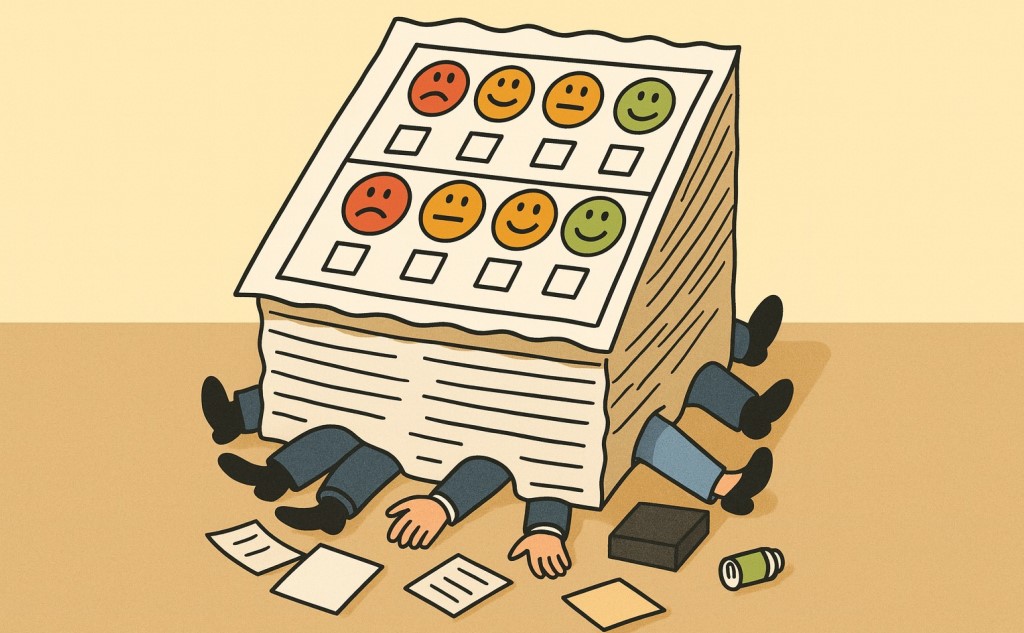
- Pulse survey fatigue: Employees who are already under operational pressure quickly perceive the constant appearance of feedback windows as an annoying obligation. Giving feedback becomes a mere “click-through” task.
- Declining response rates: As frequency increases, participation decreases. In the end, only a small, extreme group responds—those who are either highly enthusiastic or chronically dissatisfied.
- The massive bias effect: Who continues to respond when response rates decline? Primarily two groups: the extremely dissatisfied (to vent frustration) and the highly motivated. The silent, productive majority of the workforce is lost. The data foundation becomes systematically distorted.
- Dishonest responses: To get through the process quickly, employees tend to follow patterns (for example, always selecting the middle option or always choosing the maximum value). If completing pulse surveys becomes mandatory, the process ultimately turns into a farce for employees.
The result of this feedback theater is that management mistakenly believes it possesses “real-time data,” while in reality it is steering the company based on methodological noise, distorted extreme opinions, and automatic clicking behavior.
Why pulse surveys fail structurally
The biggest problem of the feedback theater, however, is not data collection but what happens afterward. If a company gathers data every two or four weeks, no manager or organizational development professional in the world has enough time to implement noticeable changes within that time frame.
Yet when employees realize that they are constantly being surveyed while little or nothing actually changes, survey fatigue turns into cynicism. Trust in the entire feedback process is then permanently destroyed.
Finish the feedback theater: The real alternative from SMART FED
This raises the question: if the traditional annual survey is too slow and pulse surveys are methodologically flawed, what is the solution?
The answer is not to pressure employees even more frequently, but to fundamentally change the way surveys are conducted.
This is exactly where SMART FED’s Agile Employee Survey 4.0 comes into play. SMART FED puts an end to the feedback theater through an entirely new approach to feedback intelligence.
1. Relevance instead of frequency
Rather than bombarding employees with standardized, repetitive questions, SMART FED relies on an intelligent, object-oriented feedback system. Employees themselves decide when and on what topics they want to provide feedback—namely when issues are personally important and relevant to them and have a positive or negative impact on their motivation, engagement, or performance.
2. From pure monitoring to organizational intelligence
SMART FED is not an app for merely measuring employee sentiment, but a strategic survey tool with a deep feedback component. The data is collected and aggregated in such a way that it can directly contribute to organizational development instead of gathering dust in HR dashboards.
3. Protection against bias effects
Through SMART FED’s specific methodology, the typical distortion effects of pulse surveys are effectively prevented. The tool ensures a valid, honest, and above all representative data foundation that management can genuinely rely on when making strategic decisions.
Conclusion: Quality beats activism
More surveys do not mean more agility. Anyone who wants to generate genuine, intrinsic feedback and sustainably develop their organization must put an end to the feedback theater of survey fatigue and data distortion.
With SMART FED’s Agile Employee Survey 4.0, companies move away from a state of constant, superficial “noise” and enter a state of genuine, evidence-based organizational intelligence. No more token clicks, but valid insights that enable efficient and effective action with the right priorities.