SMART FED vs. Traditional Employee Surveys
The Scientific Perspective
SMART FED vs. Traditional Employee Surveys
The Scientific Perspective
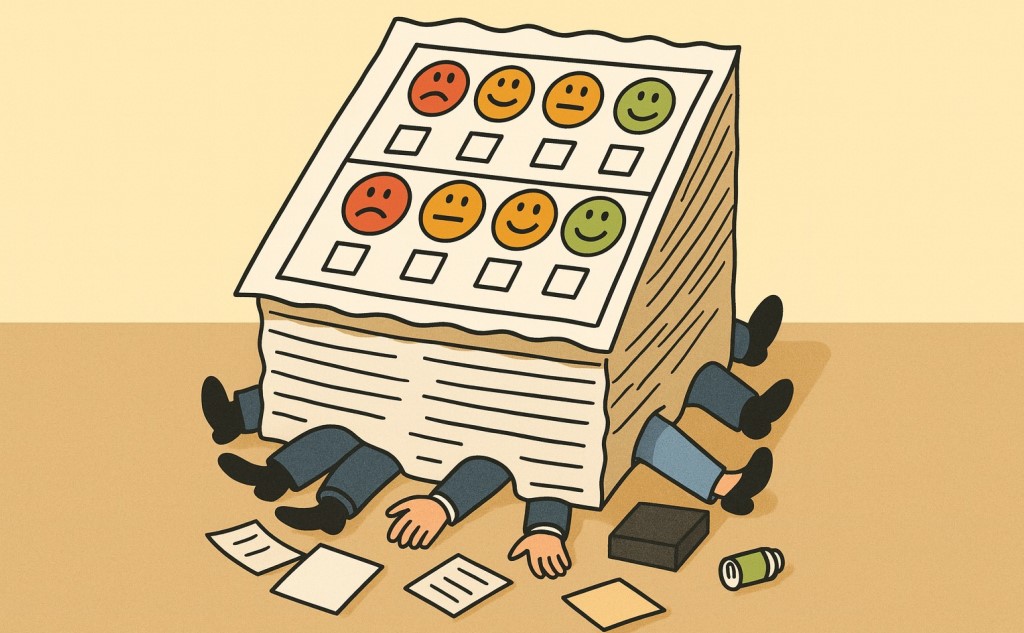
Why traditional employee surveys fall short
Over the past decade, a growing body of international research has demonstrated that classical employee surveys—typically conducted annually or biannually—are increasingly misaligned with the realities of contemporary work. Studies from the United States and Europe consistently highlight six structural limitations:
1. Limited validity and methodological constraints
Research shows that traditional surveys often suffer from response bias, social desirability effects, and low sensitivity to meaningful changes over time (Garrad & Hyland, 2020). Standardized Likert scale items tend to flatten nuance and obscure critical signals, especially in complex or rapidly changing environments.
2. Accommodation bias & social desirability
Employees tend to give answers that “sound good” (social desirability bias) rather than being completely honest—especially when it comes to sensitive topics such as leadership, conflicts, or burnout (Krumpal, 2024).
3. Lack of follow through and low impact on organizational behavior
Systematic reviews (e.g., Huebner & Zacher, 2021) demonstrate that the primary failure point of employee surveys is not data collection but the absence of effective follow up. When employees do not see visible action, trust erodes and survey participation declines.
4. Misalignment with the pace and dynamics of modern work
Annual or semi annual surveys cannot capture the fluidity of hybrid work, agile teams, or rapidly shifting organizational priorities. Scholars argue that organizations require more continuous, context specific sensing mechanisms (Macey & Fink, 2020).
5. Survey fatigue and declining engagement
Recent studies on pulse surveys (Brown, 2022) show that increasing survey frequency does not solve the problem. Instead, it often leads to fatigue, reduced honesty, and a perception of surveillance.
6. Lack of Impact & Employee Frustration
Global studies show that most employees do not believe their feedback leads to meaningful action (Machado, Forbes, 2021).
How SMART FED addresses these scientifically documented limitations
1. Individualized, contextual feedback increases validity
Employees provide feedback in the moment, in their own words, and in direct relation to their actual work context. This reduces recall bias, increases authenticity, and captures the complexity of real experiences—something traditional surveys cannot achieve.
2. Structured analytics ensure comparability and strategic insight
SMART FED transforms qualitative feedback into structured data through.
- time series analysis
- thematic clustering
- organizational mapping
This allows organizations to track trends, identify risks, and compare units without sacrificing the richness of individual perspectives.
3. Continuous feedback aligns with modern organizational dynamics
Instead of fixed survey cycles, SMART FED enables ongoing sensing. This supports agile leadership, early risk detection, and timely interventions—capabilities that research identifies as critical for organizational resilience.
4. Higher relevance reduces fatigue and increases engagement
Because feedback is situational and meaningful to employees, SMART FED avoids the fatigue associated with repetitive survey items. Employees contribute when they have something to say, not when a calendar dictates it.
Conclusion for HR Leaders
The scientific consensus is clear:
Traditional employee surveys are no longer sufficient for understanding and managing the employee experience in modern organizations.
SMART FED represents a research aligned, future ready alternative that combines:
- the authenticity of individual feedback
- the structure of systematic analytics
- the speed of continuous sensing
- the strategic clarity required by leadership
For HR leaders seeking a method that is both scientifically sound and operationally effective, SMART FED offers a fundamentally more accurate, responsive, and actionable approach to understanding the workforce.
References